
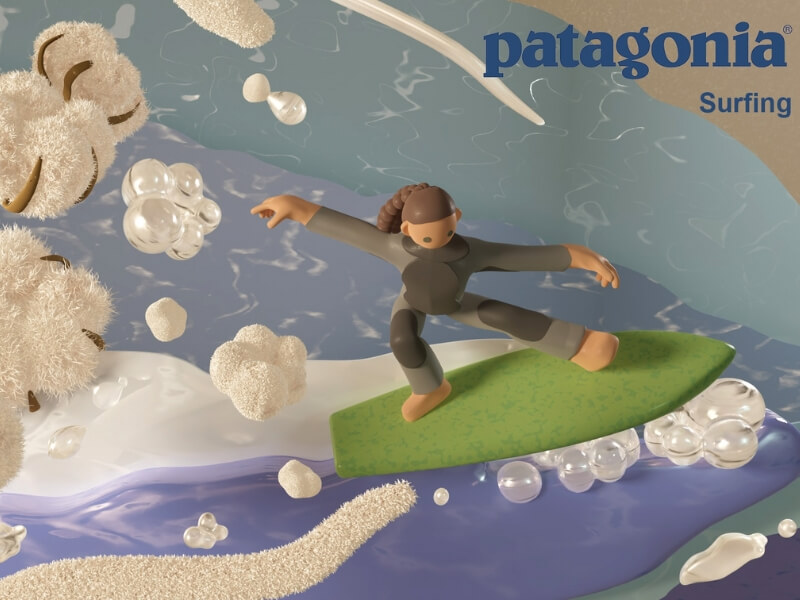
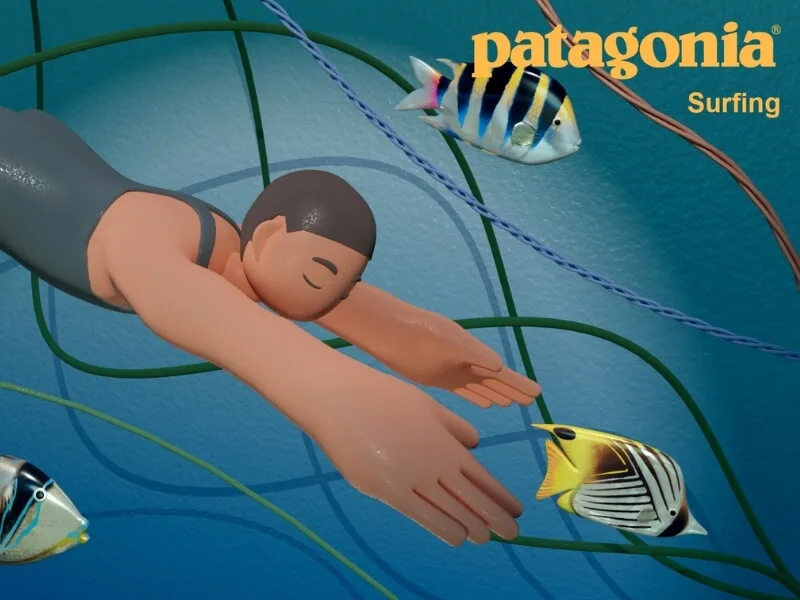
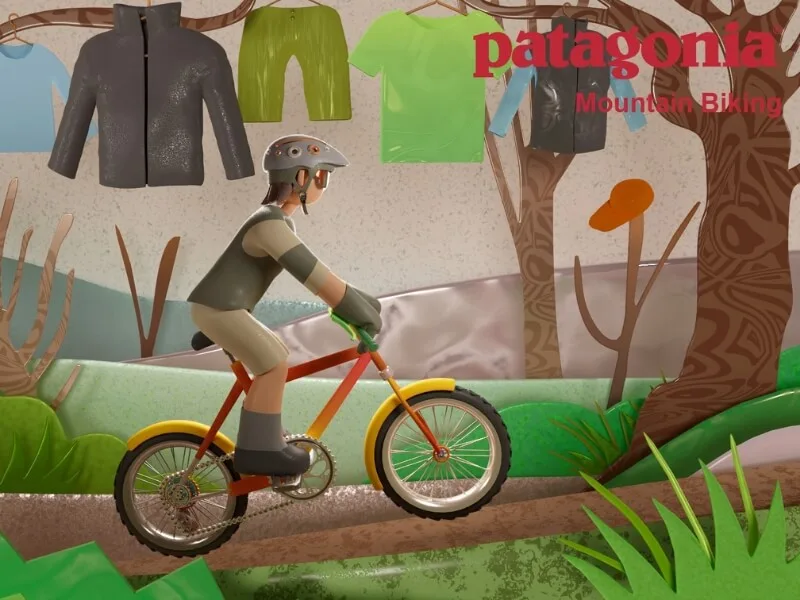
Yijun (Ivanna) Zuo’s award winning project turns Patagonia’s mission into a 3D storyboard that feels more like a journey than a product showcase. Through surfing, fly fishing, mountain biking, and climbing, the work uses earth tones and tactile textures to connect outdoor movement back to materials, craft, and sustainability.
Project Overview
This project tells Patagonia’s story through a cinematic storyboard brought to life in 3D. It follows athletes surfing, fly fishing, mountain biking, and climbing. Earth tones and textured materials flow through the frames, echoing cotton, fabric, and thread. Subtle glimpses of cloth making (spinning fibers, stitching seams) connect these moments back to the hands and craft behind each garment, weaving together nature, sport, and sustainable design.
- Winning Project Title: Nature, Sport, and Sustainability in Patagonia
- Winning Category: Advertising Integrated Campaigns, Branding and Corporate Identity, Brand Activation
Lead Designer: Yijun (Ivanna) Zuo
Interview with Yijun (Ivanna) Zuo
1. What was the brief or challenge behind your award winning project, and what key goals guided your approach?
Yijun (Ivanna) Zuo: For me, the main challenge was how to bring narrative into a 3D-driven project without losing the brand’s grounded, nature-focused identity. I wanted the work to feel more like a story than a product showcase.
My key goals were to use material and texture as part of the storytelling, reflect Patagonia’s connection to nature, and build an immersive atmosphere that makes the audience feel like they are moving through different outdoor environments. Instead of making the visuals overly polished, I focused on softer surfaces and natural textures so the 3D world would feel more tactile and emotionally engaging.
2. What sparked the initial idea for the project, and how did that concept evolve into the final design outcome?
Yijun (Ivanna) Zuo: I started the research on Patagonia’s official website to understand what products they make for each sport, and how the brand talks about its mission and values. I also looked through their social media and brand stories to get a feel for the tone they consistently communicate.
From there, I worked on a storyboard that feels cohesive across different sports. As the idea evolved, I used the research to guide the scene selection, pacing, and material choices, so the final design could feel aligned with the brand rather than something imposed on top of it.
3. Can you describe your design process for this project, from early exploration to final execution?
Yijun (Ivanna) Zuo: The process began with research. I studied Patagonia’s official website, product lines, and brand stories to understand how each sport is connected to the company’s mission and environmental values. I also analyzed their social media content to identify the consistent tone and emotional direction they use across platforms.
From there, I translated the research into a narrative structure. I mapped out how different outdoor activities could connect through movement, rhythm, and material transitions, rather than treating them as isolated scenes. This helped establish a cohesive flow early in the storyboard stage.
During exploration, I tested materials and surface qualities in 3D, focusing on the different tactile textures. At the same time, I refined compositions and character actions to ensure each frame worked individually while supporting the overall story.
In the final execution, I focused on clarity and consistency, making sure the storyboard stayed immersive, readable, and aligned with the brand’s identity.
4. What were the main challenges you faced during development, and how did you resolve them while maintaining clarity and visual strength?
Yijun (Ivanna) Zuo: One of the main challenges was keeping the visuals clear while working with 3D materials and multiple environments. As the scenes moved between water, snow, land, and fabric, it was easy for the visuals to become too complex or lose focus. I solved this by simplifying forms, controlling material contrast, and keeping lighting consistent, so each frame remained readable and visually strong.
5. What do you consider the most distinctive or successful aspect of the project, and why?
Yijun (Ivanna) Zuo: Each storyboard frame is designed to work as a standalone image for social media, while also fitting into a larger narrative sequence. This makes the work easy to adapt for posts, campaigns, or future motion content.
At the same time, the compositions and material setups were built with animation in mind, so the project has clear potential to evolve into a full motion piece later. This balance between static clarity and motion readiness makes the storyboard both practical and future proof for branding use.
6. If you had to explain this project to someone outside the design industry, what would you say is its true value or impact?
Yijun (Ivanna) Zuo: This project helps people feel what Patagonia stands for, not just see it. It’s not just about showing clothes or gear, but about showing the feeling of being outside, moving, and being connected to nature. The visuals make the brand easier to understand and remember for consumers.
7. Looking back, what is one decision you made during this project that significantly shaped the final result?
Yijun (Ivanna) Zuo: One key decision was choosing to build the project in 3D. Working in 3D allowed me to use materials in a more expressive way, and that really helped create a more immersive experience.
8. What does receiving a Design MasterPrize mean to you, and how do you see it influencing your future work or direction?
Yijun (Ivanna) Zuo: The categories are so clearly defined, which helped me understand where this project truly belongs and what direction my work naturally fits into. That clarity is really valuable, especially at this stage of my career.
It also gave me confidence to keep exploring storytelling and material-driven 3D work within branding and motion design. Moving forward, I want to develop more projects that sit between narrative, visual identity, and immersive experience, and this award helps confirm that I’m heading in the right direction.
ConclusioN
By treating material and texture as narrative devices, Ivanna Zuo’s storyboard shows how a brand story can be felt through atmosphere, movement, and craft. The result is a system of frames that reads clearly on its own, while also pointing toward future motion, campaign, and activation possibilities.