
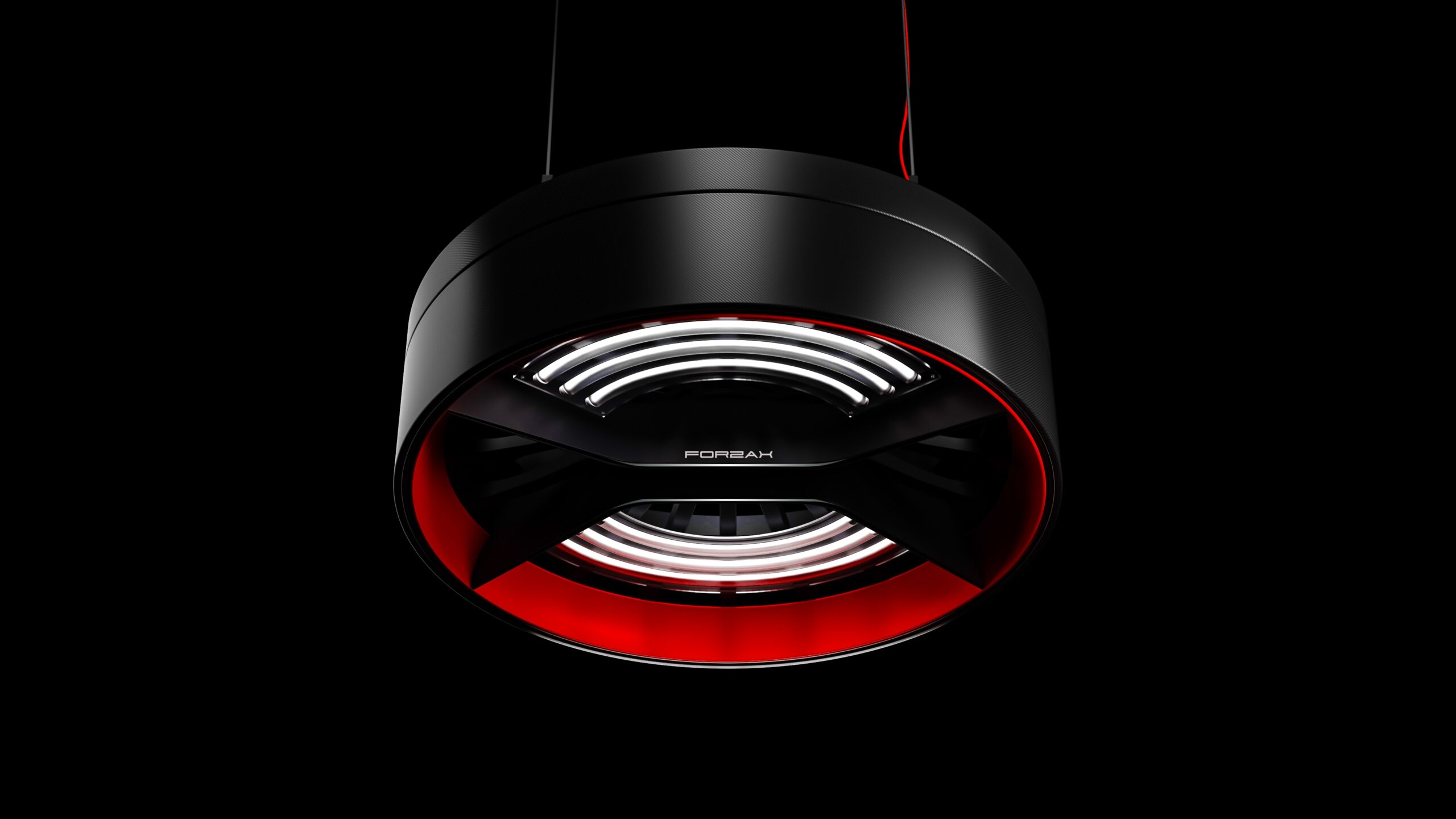
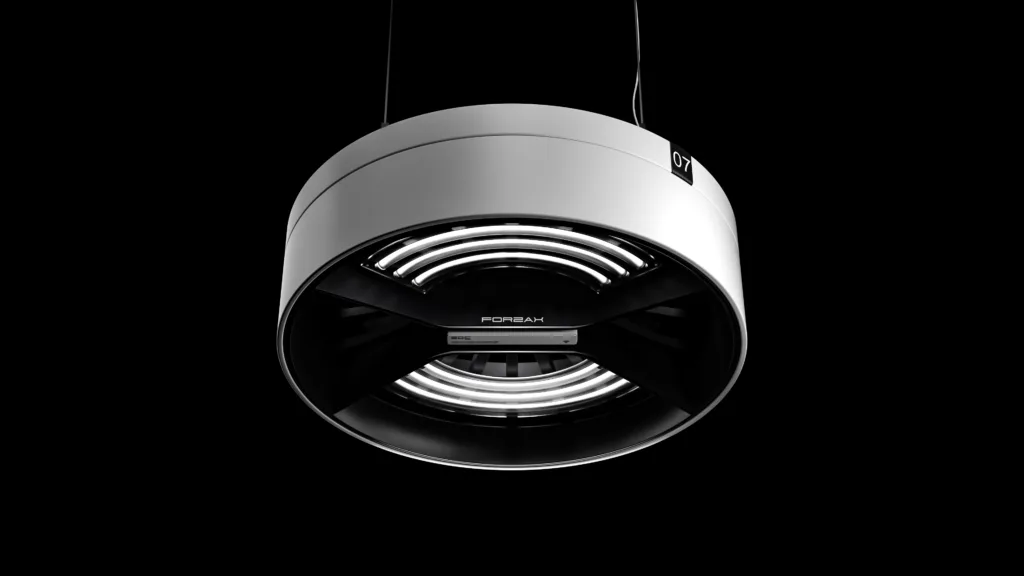
Forzax reimagines industrial lighting by merging high-performance engineering with refined, automotive-inspired aesthetics. Developed by EDC, the project challenges the traditional visual language of high-bay fixtures, introducing a design that is both functional and expressive. Lead designer Soroush Doustvandi shares how the goal was to create a lighting system that adapts across environments while enhancing the architectural quality of industrial spaces.
Project Overview
Forzax is a modular pendant lighting fixture designed for industrial environments, combining clean geometry with robust functionality. Its scalable structure supports both high-bay and low-bay applications, maintaining visual consistency across varying ceiling heights.
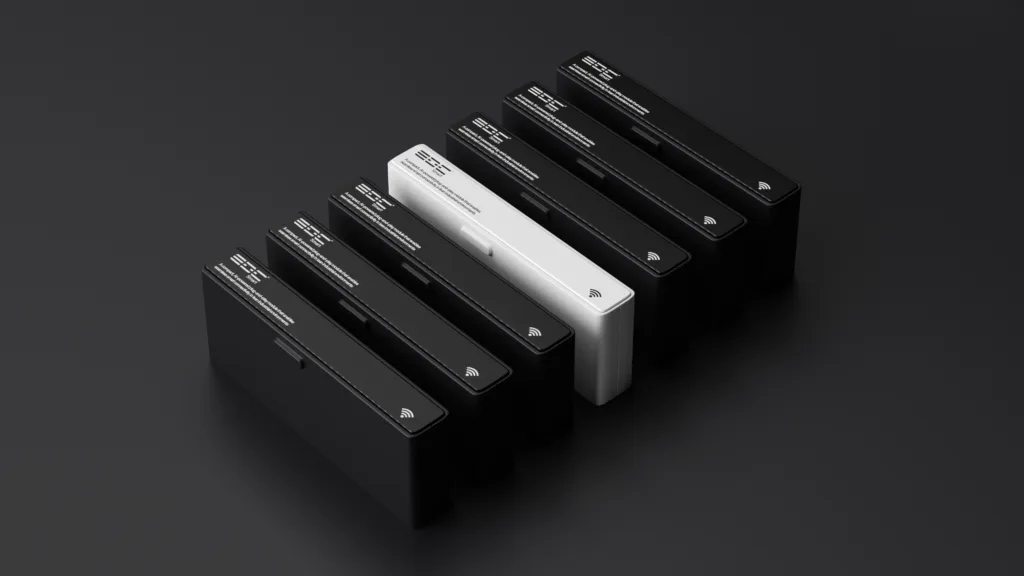
An optional AI-powered control system enables adaptive lighting based on occupancy, ambient conditions, and energy use. Designed as a product family rather than a single fixture, Forzax balances durability, modularity, and visual clarity for modern industrial spaces.
- Winning Project: Forzax
- Winning Category: Best of Best in WORK – Office Lighting
- Company: EDC
- Lead Designer: Soroush Doustvandi
- Design Team: Ali Dehghan, Mohammad Dehghan, Mohammad Hakiminia
Interview with Soroush Doustvandi
1. What was the brief or challenge behind your award-winning project, and what key goals guided your approach?
Soroush Doustvandi: The primary challenge was that most existing high bay lighting fixtures are designed only for technical performance and lack aesthetic quality. Our client asked us to rethink this category and create a lighting product that not only delivers reliable illumination but also contributes positively to the visual character of the space.
One of the main goals was to design a form that could work in both high ceiling industrial environments and in lower ceiling applications where the fixture is more visible and needs a higher level of visual refinement. Another important goal was future readiness. The product needed to be capable of integrating smart and intelligent control systems as optional add-ons, without forcing complexity on projects that did not require them.
Finally, the design had to support a clear product strategy. The same core design needed to work across multiple versions, from an economical configuration to more advanced and premium options, while maintaining a consistent identity and performance logic.
2. What sparked the initial idea for the project, and how did that concept evolve into the final design outcome?
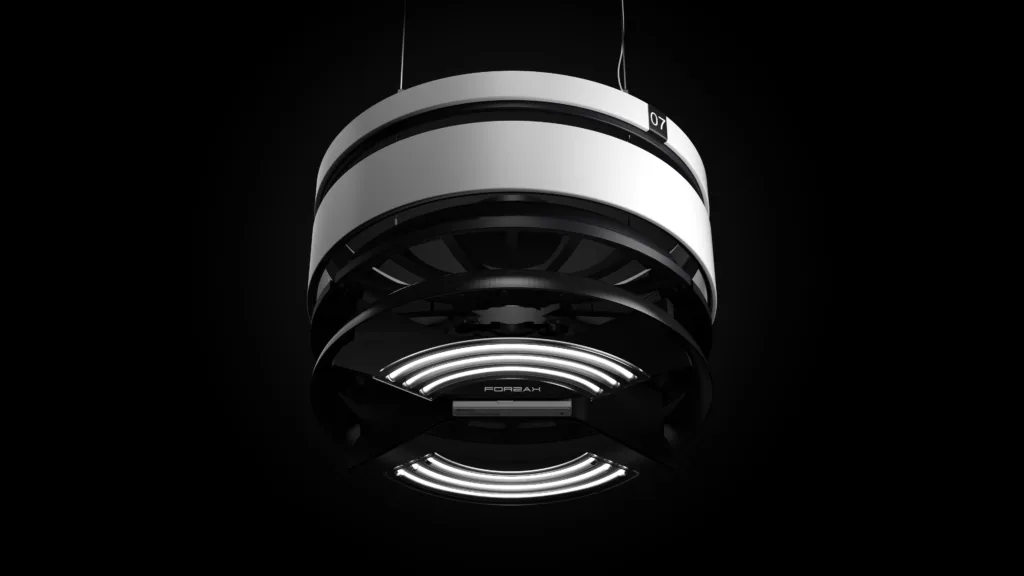
Soroush Doustvandi: The first idea came from the concept of visible modularity, both in the form of the product and in its light sources. We wanted the structure of the fixture to clearly express how it works, rather than hiding its logic behind a single closed volume. In Forzax, this idea is embodied in two visible blades that divide the form and organize the lighting system into separate LED and lens modules.
This modular structure allowed us to precisely control light output while avoiding unnecessary cost in economical versions and preventing over-illumination in spaces with lower ceiling heights, such as general aisles. From the beginning, designing a system was more important to us than creating a single product. As the project evolved, this approach naturally expanded into a scalable product family that supports different performance levels, smart control options, and spatial requirements, all while maintaining a consistent and recognizable design language.
3. Can you describe your design process for this project, from early exploration to final execution?
Soroush Doustvandi: The first phase of the project focused on clearly defining the problem. We began with market research and direct feedback from both our business-to-business (B2B) distributors and business-to-consumer (B2C) users, which helped us understand technical expectations, visual shortcomings, and real use cases in different environments.
Based on these insights, we moved into a broad sketching phase, exploring ideas divergently before gradually curating and refining them through a convergent process. During this stage, the form was shaped in close relation to the existing design DNA of our Series 5 products, ensuring consistency within the broader portfolio.
In parallel, we developed the technical core of the product by selecting appropriate LED modules and lenses, while also designing an optional smart add-on in cooperation with our smart division. At the same time, we worked on color, material, and finishing decisions, balancing durability requirements with a refined visual presence.
In the final stages, our product engineering team reviewed assembly logic, explored the feasibility of a screwless approach, and validated the overall structure. Physical prototypes were produced, followed by the preparation of technical documentation and production files to support mass manufacturing.
4. What were the main challenges you faced during development, and how did you resolve them while maintaining clarity, usability, or visual strength?
Soroush Doustvandi: One of the main challenges in developing this project for mass production was reducing the number of parts in order to control molding costs, surface finishing time, and assembly complexity. In particular, it was challenging to design the main body of the fixture as a single aluminum component while still allowing variation in color and surface finishing across different product versions.
At the same time, we needed to carefully balance weight reduction with structural stiffness and thermal performance. Since the base of the light also functions as the primary heat sink for the LED modules, reducing material could not compromise heat dissipation or durability. Through iterative engineering studies, we identified optimal material thicknesses and geometries that achieved both mechanical stability and effective thermal control.
These decisions allowed us to create a scalable product family. The economical versions use lower power configurations and exclude smart components, while the premium versions incorporate more complex elements, smart add-ons, and higher quality coatings and finishes. This approach maintained visual clarity and a consistent design language while supporting different performance levels and market expectations.
5. What do you consider the most distinctive or successful aspect of the project, and why?
Soroush Doustvandi: Many companies develop product forms by following familiar references within their own industry. As the design lead on this project, I intentionally chose a different approach by using automotive design as a source of inspiration for the overall form language. This way of thinking is more commonly seen in transportation or sports footwear design, where speed, flow, and performance are expressed visually, but it is rarely applied to industrial lighting products.
By applying an interdisciplinary design approach, we were able to explore forms that feel more dynamic, expressive, and refined, while still remaining functional and manufacturable. This mindset allowed us to move beyond conventional lighting geometries and create a product that feels both technical and visually engaging. I believe this cross-disciplinary way of thinking is what gives the project its distinctive character and helps it stand out in a category that is often visually repetitive.
6. If you had to explain this project to someone outside the design industry, what would you say is its true value or impact?
Soroush Doustvandi: One of the main goals of EDC is to improve the visual quality of lighting products, first in the Middle East market and then on a global level. Because of this, the first impression of a product is extremely important to me when I design. Before performance is even evaluated, people react emotionally to what they see.
The true value of this project lies in its ability to immediately connect with people through its form. The product is visually engaging and easy to relate to because its design language is inspired by automotive forms, which most people are already familiar with. Our eyes naturally recognize and respond to these shapes. As a result, the light does not feel like a purely technical object, but rather something expressive and approachable. This strong visual impact helps the product stand out and makes advanced lighting feel more accessible and desirable.
7. Looking back, what is one decision you made during this project that significantly shaped the final result?
Soroush Doustvandi: One of the most important decisions I made was to fully commit to a clear point of differentiation. I asked the design team to deliberately move away from familiar lighting forms and avoid relying on common points of parity within the category. This was a calculated risk, as design projects usually require a careful balance between being recognizable and being different.
Choosing to prioritize differentiation meant accepting uncertainty, but it allowed us to create something genuinely new rather than a variation of existing products. This decision shaped the identity of the project and gave it a strong presence in the market. Looking back, I believe this commitment to originality was essential in achieving a distinctive and memorable result.
8. What does receiving a Design MasterPrize mean to you, and how do you see it influencing your future work or direction?
Soroush Doustvandi: Being recognized as part of a group of world-class designers is a great honor for me and my team. When I saw the results and realized that our work had received a Best of Best distinction, it confirmed that our approach meets international standards and is ready to confidently enter the global market. This award represents an important milestone, not only for this project, but for the direction of all my future work.
It also strengthens trust. For our clients, having an award-winning product in their portfolio brings confidence and credibility. Recently, several companies have shared with me that they are interested in investing more seriously in their design centers and research and development, with the goal of achieving design excellence rather than relying heavily on marketing alone. When a product is well designed, it communicates its value by itself.
I would also like to sincerely thank the Design MasterPrize team, the jury members, and the Farmani Group, especially Mr. Hossein Farmani, for their continued efforts in building meaningful global platforms that support design excellence. I wish continued success to all designers and contributors in the next editions of the award.
ConclusioN
By combining modular engineering with a refined, automotive-inspired design language, Forzax redefines what industrial lighting can be. Soroush Doustvandi and the EDC team demonstrate how performance-driven products can also contribute to spatial quality and visual identity, turning functional lighting into an integral part of architectural experience.