
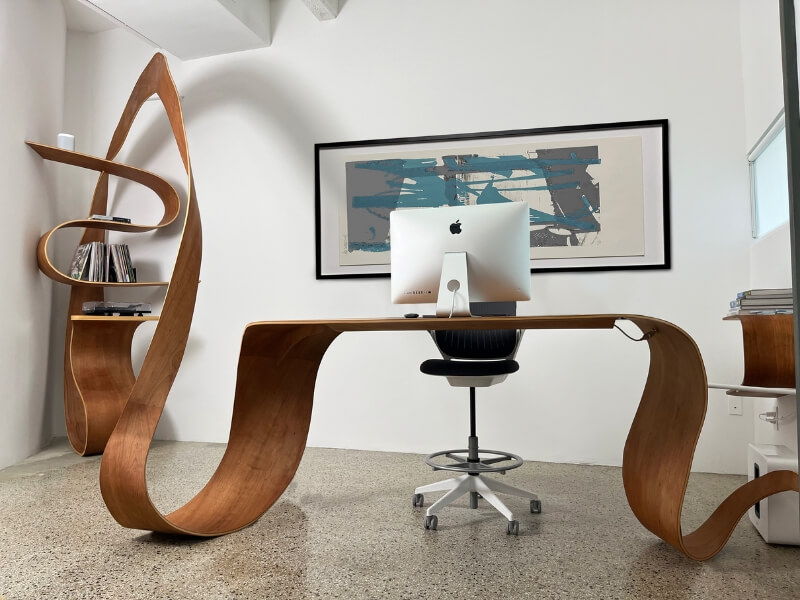
Ribbon Desk turns a client’s “we can do anything” ethos into a single continuous form that flows through an office, shaping a desk, shelving, vinyl display, and seating into one interconnected piece. Architect and designer Scot DiStefano shares how the concept was born from a showroom moment, then refined through VR modeling and fabrication research inspired by Formula 1 engineering.
Project Overview
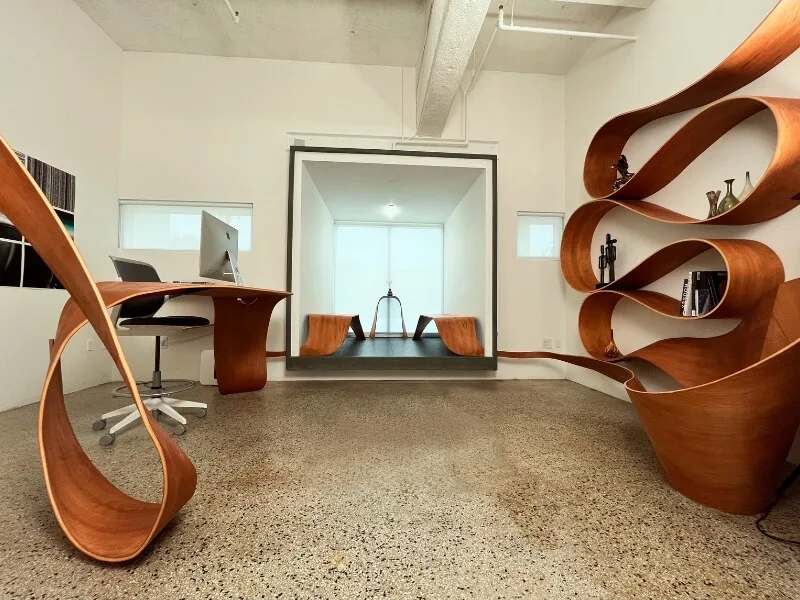
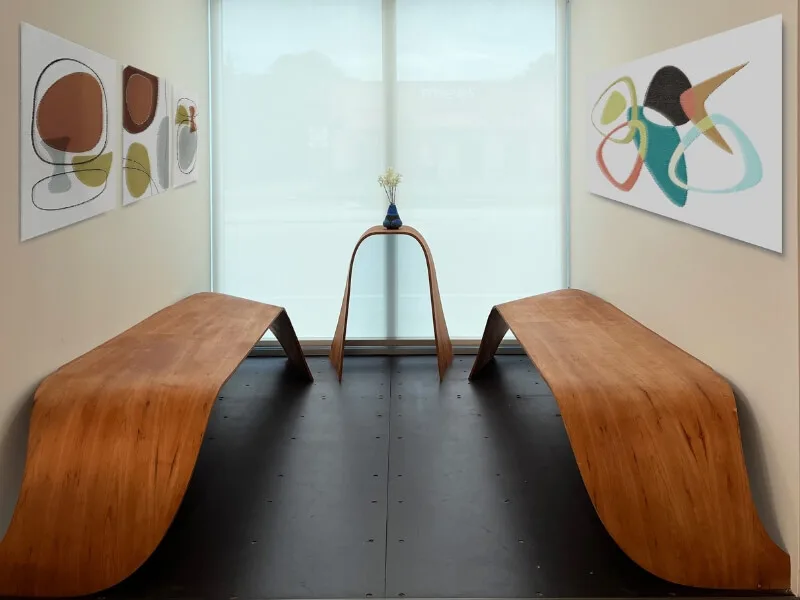
Ribbon Desk is a bespoke built in that flows continuously through the office, uniting desk, vinyl display, seating, and shelving into a sculptural, multifunctional form. Developed from a request for a fully interconnected unit, it moves like a continuous ribbon, disappearing and re-emerging to define zones with intention and artistry. Crafted from laminated cherry veneer, it merges warmth with structural innovation. Refined through extensive R&D, its sectional construction and concealed supports deliver a seamless, immersive form that reflects the project’s creative ethos.
- Winning Project Title: Ribbon Desk
- Winning Category: Work (Office)
- Firm Location: Dania Beach, United States
- Company: VMS, VerveMulti Studio
- Lead Designer: Scot DiStefano
- Design Team: Luke Jenkins, In Bloom Studio (Fabricator)
- Client: Marc Aptakin
Interview with Scot DiStefano
1. What was the brief, and what key goals guided your approach?
Scot DiStefano: Creating a free-flowing form that was structurally sound and as thin as possible, specifically, the client wanted a bespoke piece of furniture, with specific program requirements, that spoke to his personality and his companies “we can do anything” ethos.

2. What sparked the initial idea, and how did the concept evolve?
Scot DiStefano: The client had seen an ad for a company in India that sold wood veneers. We had just finished another project using veneered plywood. In the veneer supplier showroom, there was a floating soffit made from wood veneers over a waffle slab structure. As we talked it through, why he liked it and what he was looking for programmatically, the word “ribbon” came up and the concept was born.
3. Can you describe your design process, from early exploration to final execution?
Scot DiStefano: I always start with pencil on paper, usually in my sketchbook. From there I took it into CAD and drew it in plan and elevations. From there, we took the design into Maya and modeled it for VR so the client could experience the design. We went through two major iterations with that process, and of course, a million minor alterations to fine tune the design.
The Maya files also proved critical to the fabrication process.
4. What were the main challenges during development, and how did you resolve them?
Scot DiStefano: Materials and methods was the main obstacle. For me, the most important detail was the thickness of the structure. I wanted it to be as true to the ribbon concept as possible, and therefore as thin as possible. We had set a limit of 3/4″ for the thickness of the ribbon and the final version came in at 7/16″ thick.
5. What do you consider the most distinctive or successful aspect of the project, and why?
Scot DiStefano: That we delivered on the client’s request is the most important success. As an artist I aspire to what I want, but as an architect we are solving a problem for a client. That realm where the client is getting what they requested, and the architect working in a zone that speaks to who they are, is nuanced and often a moving target. But there is nothing more satisfying, as an architect, than to see that smile form on the client’s face and know you’ve nailed it.
6. If you had to explain this project to someone outside design, what would you say is its true value?
Scot DiStefano: I think it reflects the spirit of problem solving, analyze, research, explore, doubt, repeat!
7. Looking back, what is one decision that significantly shaped the final result?
Scot DiStefano: Researching how the parts for F1 cars are created was critical to the process. They need it as light and as strong as possible, and so did we. Understanding the process used to create carbon fiber body parts was key to figuring out how to build this desk.
8. What does receiving a Design MasterPrize mean to you, and how do you see it influencing your future work?
Scot DiStefano: I am humbled to keep the company of so many talented designers and creatives, and to have caught the attention of the judges. I hope it leads to a call from someone else who needs a problem solved that takes form and function to new limits.
ConclusioN
Ribbon Desk shows what happens when program requirements and personality are treated as design material. The result is an office environment shaped by one continuous gesture, then made real through careful modeling, prototyping, and structural discipline.